- (419) 491-8767
- info@treeservicestoledoohio.com
- Office: Mon - Fri 10:00 - 18:30 | 24/7 Emergency

Tree Cabling and Bracing Toledo Ohio
A steel cable high in the crown or a rod through a weak fork can help a valued tree hold together in wind and ice. Our crew installs tree support systems in Toledo and tells you plainly when a tree is not a candidate.
Get a Free Estimate
Tell us what you need and we will call you back.
By sending this form you agree to our Privacy Policy.
About Our Tree Cabling and Bracing Service
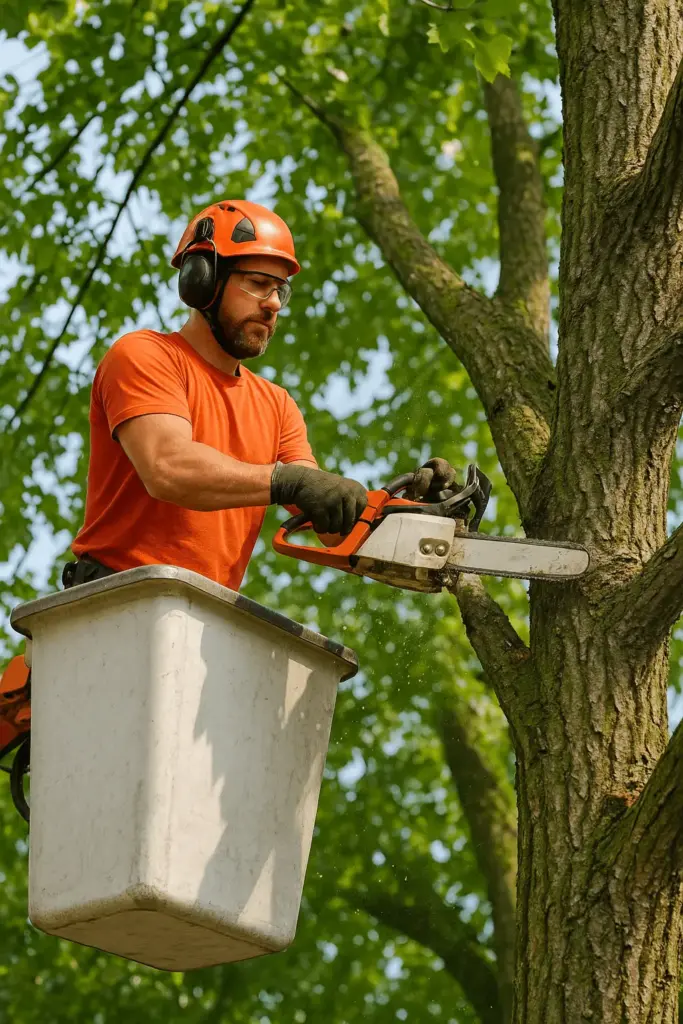
Cabling and bracing add support where a tree’s own structure is weak. A cable is installed high in the crown between two stems or limbs so they share the load and cannot spread too far apart. A brace rod is a threaded steel rod bolted through a weak or cracked union to hold both sides together. The two are often used as a pair, usually alongside weight-reducing tree trimming. Whether your tree suits this work starts with an arborist assessment of the union and the wood around it.
Our Cabling and Bracing Process
1. Inspect the Union
We study the fork or limb that worries you: its angle, any crack, bark trapped inside the union and signs of decay. We also check the trunk and root flare, because support hardware is wasted on a failing base.
2. Lighten the Load
Before any hardware goes in, we prune to take weight off the weak part. Shortening long, heavy limbs and thinning their ends means the cable has less to hold when wind or ice arrives.
3. Install the Hardware
Cables are anchored high in the crown, well above the weak union, and tensioned just enough to take up slack. Where a fork is cracked or tightly V-shaped, a brace rod is drilled and bolted through it.
4. Plan the Rechecks
A support system is not something to install and forget. We note what went in and where, and recommend having it looked at periodically and after major storms, since trees grow and hardware wears.
Why Choose Us for Cabling and Bracing?
Support hardware only makes sense on the right tree, so our advice begins with whether to do it at all.
- Candidates only. We install cables and rods where sound wood can hold them, and say no where it cannot.
- Pruning in the same plan. Weight reduction is considered with every support system we propose.
- Plain talk about risk. We explain that hardware lowers the chance of failure and does not remove it.
- A record of the install. You get a note of what went in and where, ready for later inspections.
- Removal when it is the better answer. If a tree is past supporting, we tell you.
Benefits of Tree Cabling and Bracing
Keep the Tree
A mature shade tree takes decades to replace. Supporting a weak fork can let you keep the tree and its shade, instead of losing it over one structural flaw.
Less Storm Movement
A cable limits how far two stems can pull apart in a gust or under ice. Less movement at the union means less strain on the point most likely to split.
Cracks Held Together
A brace rod clamps a split union so the two halves act more like one piece again. That helps keep the crack from working open a little further each windy day.
Lower Risk Underneath
When a heavy limb hangs over a roof, driveway or patio, added support reduces the odds of it landing there. The tree is not risk-free afterward, but the odds are better.
Is Cabling Right for Your Toledo Tree?
Cabling suits a healthy, valued tree with a structural weak point, such as a tight V-shaped fork or one long, heavy limb over the house. Northwest Ohio summer storms and winter ice put real load on those weak points. It is not a fix for a dead or badly decayed tree. Our tree cabling and bracing guide explains which trees qualify.
A trunk that has already started to split needs a quick decision. Read whether to cable or remove a split tree before the next storm.
Price ranges are in our tree cabling cost guide. If the tree cannot be saved, see tree removal in Toledo.
Testimonials
Cabling on our split-leader sugar maple in the Old West End was installed with discreet hardware. The arborist explained inspection intervals and provided a written maintenance plan. The tree looks natural and stable again.
Robert King
Homeowner, Toledo, Ohio
They braced a heritage oak over the courtyard at offices near ProMedica and coordinated lift access outside patient hours. Engineering specs were included in the report for our insurer. Movement in high winds is now minimal.
Dana Li
Facilities Manager, Summit Medical Plaza, Toledo
Follow-up after a wind event included tension checks, light pruning, and photos of anchor points. We appreciated the clear documentation and reminders for annual inspections. The workmanship inspires confidence.
Yolanda Perez
Property Manager, Uptown Lofts, Toledo
Frequently Asked Questions
Which trees are good candidates for cabling and bracing?
The usual candidates are otherwise healthy trees with one structural weak point: two co-dominant stems of similar size, a tight V-shaped union with bark pinched inside it, or a long, heavy limb reaching over a house or driveway. Trees with several trunks often have forks like these. The wood where the hardware anchors has to be sound, which is why inspection comes first.
What can cabling and bracing not fix?
Hardware supports sound wood. It does not cure decay. A hollow or rotten trunk, a dead tree, or a tree whose roots are failing or lifting will not be made safe by a cable, because the weakness is not in the fork. In those cases the hardware has nothing solid to hold onto, and we will talk with you about other options, often removal.
Is a cabled tree safe?
Safer, not safe. A support system lowers the chance that the weak part fails, but no hardware can promise a tree will stand through every storm. Cables and rods also need periodic inspection, because the tree keeps growing, anchors can be overgrown and cable can wear. Have the system checked on a regular schedule and after any severe weather.
When is removal a better answer than cabling?
Removal makes more sense when a crack runs well down the trunk, when there is decay at the union, when much of the crown is already dead, or when the tree would land on a bedroom or a busy area if the hardware ever failed. Where both options are reasonable, we lay out each one and tell you which we would choose and why.
Get a Free Estimate
By sending this form you agree to our Privacy Policy.