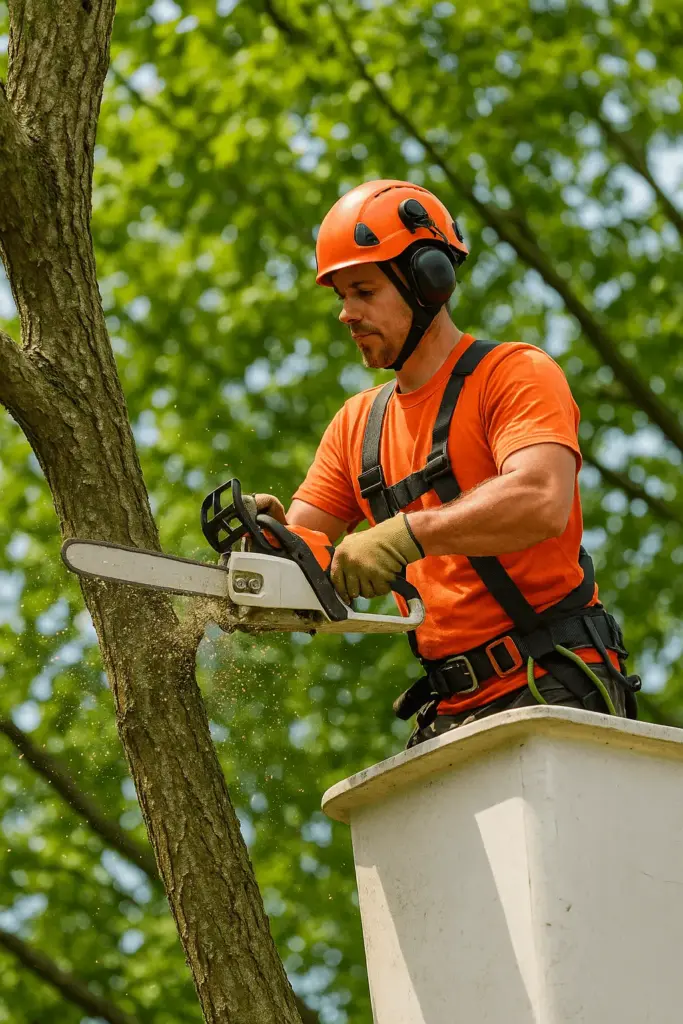
Quick answer: A dead ash is more dangerous than most dead trees because the wood dries, cracks and drops limbs with little warning, sometimes on a calm day. Purdue University advises removing ash before it dies or loses major limbs. Published guides put ash removal at about $250 to $1,800 nationally as of October 2026, and nearby buildings or power lines push the price up.
A standing dead ash is not a job to leave until it is convenient. This guide explains why the wood fails, how the work is done and what published price guides say. If you want the tree looked at now, see dead ash tree removal in Toledo.
Why is a dead ash different from other dead trees?
It dries out fast. The Purdue Landscape Report explains that ash moves water through only a thin ring of tissue under the bark. Emerald ash borer larvae chew through that ring, so the tree loses moisture quickly and the structural wood becomes prone to cracking. The cracks are often hidden by bark.
This was measured close to home. A 2013 study in Arboriculture & Urban Forestry, the research journal of the International Society of Arboriculture, tested green ash in Perrysburg. Branches from infested trees with dead canopies had lower moisture and more cracking where they broke, and only infested trees failed at the branch union. Badly infested trees also showed weaker wood at the base of the trunk.
Decay follows. An Ohio State University Buckeye Yard and Garden Line article notes that ash has little resistance to rot once exposed, so fungi keep weakening trunks and limbs for years.
How quickly does a dead ash become unsafe?
Sooner than it looks. The Perrysburg study concluded that ash can be structurally compromised as early as one to two years after infestation, while it may still look fairly healthy. The study was small, 25 trees in all, and the authors say further research is needed.
Purdue reports sizable limbs snapping about 30 feet up on a calm day. No source gives a safe waiting period. Purdue’s advice is to leave a dead ash standing only where no person, pet or property could ever be in its path, and otherwise to stay away from it until it is down. For how the infestation reached this point, see emerald ash borer in Toledo.
How do crews remove a dead ash?
Often without climbing it. Purdue Extension says dead ash is much harder to cut down than living ash. A Tree Care Industry Magazine article explains why: the wood turns brittle but stays hard, so tapping or drilling the trunk can make it seem sound when it is not. The article recommends aerial lifts or other access methods for trees in that condition.
In practice that means a bucket truck or lift where one can reach, and sometimes a crane where it cannot. Both add equipment to an ordinary tree removal. This is not a do-it-yourself job. The Ohio State article warns that cutting unstable dead ash with a chainsaw is dangerous work for anyone without experience.
What does dead ash removal cost?
The business has not published a price list, so the figures below are third-party estimates as of October 2026. An on-site quote is the only real price.
| Published figure | Range | Publisher |
|---|---|---|
| Ash tree removal (national) | $250 to $1,800 | HomeAdvisor |
| Any tree 30 to 60 feet tall (national) | $450 to $1,200 | HomeAdvisor |
| Any tree 60 to 80 feet tall (national) | $800 to $1,500 | HomeAdvisor |
| One medium tree in Toledo | $597 to $810 | Homeyou |
| Crane, when one is needed (national) | $250 to $600 per day | HomeAdvisor |
| Stump grinding (national) | $120 to $500 | HomeAdvisor |
The national figures are from HomeAdvisor’s tree removal cost guide, and the local one is from Homeyou’s Toledo page. Neither is specific to dead trees.
Waiting tends to raise the bill. University of Wisconsin Extension says removing an ash while it is still structurally sound can be safer and cheaper, and that nearby structures or power lines raise removal costs.
Who is liable if a dead ash falls?
In Ohio it turns on what the owner knew. Ohio State University Extension’s Agricultural and Resource Law Program explains that a tree owner may be liable for damage to a neighbor only if the owner knew the tree was diseased, weak or patently dangerous. Once you know your ash is dead, you can no longer say you were unaware.
Purdue adds that many insurers have begun refusing to pay for damage caused by dead falling trees, so ask your agent how your policy treats it. This is general information, not legal or insurance advice.
If the ash stands in the strip between the sidewalk and the curb, it is a City tree. The City of Toledo’s street tree FAQ says pruning or removing a street tree without a permit violates the municipal code, and that residents should report concerns to Engage Toledo at 419-936-2020.
What comes after removal?
Decide on the stump, then replant with something other than ash. Our guide to trees to plant in place of ash lists options by yard type.
Dead ash tree FAQs
Is a dead ash tree dangerous?
Yes. Purdue Extension describes dead and dying ash as extremely brittle and likely to crack and drop limbs on people and property.
Can I cut down a dead ash tree myself?
It is a poor idea. The wood can fail without warning while you are cutting, which is why Purdue and Ohio State both point homeowners to experienced professionals for dead ash.
Can I use the wood as firewood?
Yes, but use it locally. Purdue’s emerald ash borer FAQ says the insect spreads long distances in firewood and logs, so wood from a dead ash should not be moved far from where it was cut.
Sources
- Purdue Landscape Report: Avoid Deadly Risk of Dying Ash Trees with Timely Tree Removal
- Arboriculture & Urban Forestry: Effects of Emerald Ash Borer Infestation on the Structure and Material Properties of Ash Trees
- Ohio State University Buckeye Yard and Garden Line: Ash Breakage, the Hazard Continues
- Purdue University Extension Entomology: Emerald Ash Borer, Personal Safety
- Purdue University Extension Entomology: Emerald Ash Borer FAQ
- Tree Care Industry Magazine: Climbing and Rigging Critical-Risk Ash Trees
- HomeAdvisor: How Much Does Tree Removal Cost?
- Homeyou: Tree Removal Costs in Toledo, OH
- University of Wisconsin Extension: Is My Ash Tree Worth Treating for Emerald Ash Borer?
- Ohio State University Extension Farm Office: Trees Near Rural Property Boundaries, What Are the Laws?
- City of Toledo: Street Trees FAQ

PK Barmon researches and writes the tree care guides on Tree Services Toledo Ohio. Every guide is built from primary sources such as Ohio State University Extension, the City of Toledo and Ohio state agencies, and each one lists its sources so you can check them.