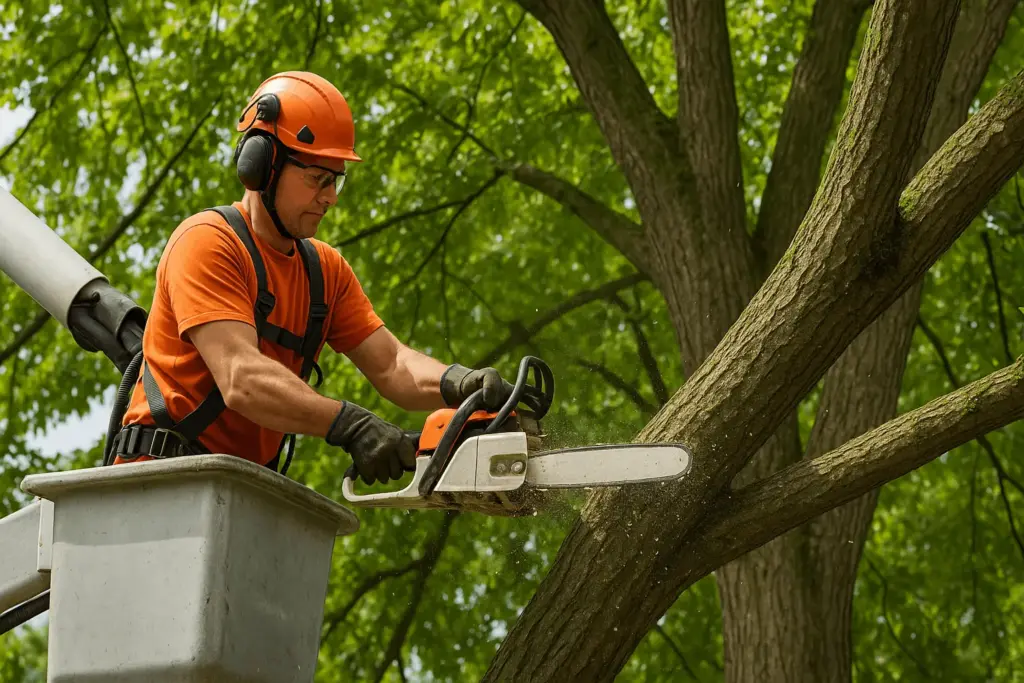
Quick answer: Have the trees that could reach your house, driveway or power line inspected, remove dead wood, shorten overextended limbs with proper cuts, support weak forks that are worth keeping, and keep branches clear of the roof and the service line. Do it before storm season. In Ohio, schedule oak pruning outside April 15 to July 1 because of oak wilt.
No preparation makes a tree storm-proof, but many defects can be found and managed ahead of time. This checklist follows arborist and extension guidance, and there is storm damage cleanup if the worst happens.
What is the storm prep checklist?
| Step | What to look for | Who does it |
|---|---|---|
| Inspect | Dead or hanging branches, cracks, cavities, mushrooms at the base, heaving soil | You first, then an arborist |
| Remove deadwood | Dead, dying, diseased or weakly attached branches | An arborist, if off the ground |
| Shorten long limbs | Heavy limbs with most of their leaves at the tips | An arborist |
| Support weak forks | Twin trunks with bark trapped between them | A qualified arborist |
| Clear roof and service line | Branches touching the roof or the line to the house | An arborist. Never do it yourself near wires |
How do you start with an inspection?
The International Society of Arboriculture’s Recognizing Tree Risk guide lists what to check: large dead branches, detached hanging branches, cracks or splits, cavities or rotten wood, mushrooms at the base, and any history of topping or heavy pruning. A yes to any of them means the tree should be examined by an ISA Certified Arborist.
Purdue Extension’s Trees and Storms publication advises inspecting trees each year for broken, dying, diseased and dead branches. For the species side, see which trees fail most in storms.
Why remove deadwood and shorten long limbs?
Removing dead, dying, diseased and weakly attached branches is what ISA calls cleaning. Long, heavy limbs are the next concern: Purdue Extension’s Large Tree Cabling and Bracing guide says overextended limbs often break where the branch meets the stem, and that early corrective pruning is the best prevention.
Purdue says a tree should under no circumstances be topped to prevent wind or ice damage, and warns against trying to wind-proof a tree by thinning out its branches. ISA’s Pruning Mature Trees guide says that, in general, no more than 25 percent of the crown should come off at once. Book tree trimming before storm season.
For oaks, timing is a disease issue. Ohio State University Extension’s oak wilt fact sheet says oaks should never be wounded between April 15 and July 1.
When should a weak fork be supported?
Purdue’s cabling guide names codominant stems, two trunks of similar size, as the most common risk of tree failure, partly because bark gets trapped between them. Where the tree is otherwise healthy, cables high in the crown limit how far the stems can move, and brace rods through the union reduce the risk of the stems spreading apart.
The guide is frank about the limits. Support systems are no guarantee against failure, installation is best left to qualified arborists, and the hardware needs a ground check every year, a climbing inspection about every three years, and perhaps replacement after 7 to 10 years. Ask about cabling and bracing, or read how tree cabling and bracing works.
Who clears the roof and the service line?
Branches over the roof are yours to deal with, and clearing them is ordinary pruning. Wires are different. ISA’s risk guide is blunt: never try to remove branches from or near power lines.
Toledo Edison, a FirstEnergy subsidiary, trims along its own lines on a four-year cycle, according to a FirstEnergy news release. The line from the pole to your house is treated differently. The Office of the Ohio Consumers’ Counsel says that on service lines usually only branches growing on or through the wires are removed. FirstEnergy’s tree problem page asks customers not to work on trees near power lines, and says that removing a tree between the pole and the home means disconnecting the service first, which may carry a fee. This is general information, not legal advice.
What about young trees?
ISA’s Pruning Young Trees guide says to remove or shorten all but one of any competing leaders while the tree is young. On a newly planted tree, it limits pruning to dead or broken branches until the second or third year. Purdue adds that young trees should not be staked unless absolutely necessary.
What should you do after a storm?
Stay clear of damaged trees. ISA’s Storm-Related Tree Damage guide warns that limbs under tension can react unexpectedly when cut or moved, and that damaged trees may be in contact with electrical wires. Purdue says to treat every utility line as energized. ISA adds that large trees that look undamaged should still be checked by an arborist for cracks, hanging branches and soil heaving.
Storm prep FAQs
When should you prepare trees for storm season in Toledo?
ISA says light removal of dead, weak or diseased limbs can be done at any time of year, and that pruning before the spring growth flush is best for growth and wound closure.
Does thinning a tree make it safer in wind?
Purdue Extension advises against thinning branches to wind-proof a tree. It says to prune out dead, diseased, crossing and poorly attached branches instead.
Will cabling stop a tree from splitting?
It lowers the risk and does not remove it. Both Purdue and ISA say supports are not a guarantee against failure.
Sources
- ISA (TreesAreGood): Recognizing Tree Risk
- ISA (TreesAreGood): Storm-Related Tree Damage
- ISA (TreesAreGood): Pruning Mature Trees
- ISA (TreesAreGood): Pruning Young Trees
- Purdue Extension: Trees and Storms (FNR-FAQ-12-W)
- Purdue Extension: Large Tree Cabling and Bracing (FNR-550-W)
- Ohio State University Extension: Oak Wilt (PLPATH-TREE-02)
- Office of the Ohio Consumers’ Counsel: Utility Line Clearing and Tree Trimming
- FirstEnergy: Tree-Trimming Work Underway in Northwest Ohio
- FirstEnergy: Report Tree Problem

PK Barmon researches and writes the tree care guides on Tree Services Toledo Ohio. Every guide is built from primary sources such as Ohio State University Extension, the City of Toledo and Ohio state agencies, and each one lists its sources so you can check them.