Quick answer: Get everyone out from under the damaged part of the house, stay at least 30 feet from any downed wire, and call 911 if someone is hurt, a line is down or you smell gas. Then report the outage to Toledo Edison at 1-888-544-4877, photograph everything before it is moved, and call your insurer before the tree is cut up.
The order matters: people first, then your insurance claim. Once the scene is safe, getting the trunk off the roof is a job for a crew that does emergency tree removal in Toledo. This article is general information, not insurance advice.
What should you do in the first five minutes?
- Move everyone out. Get people and pets out of the rooms under the tree. If the roof line, ceiling or walls have shifted, leave the house.
- Look for wires from a distance. FirstEnergy, the parent company of Toledo Edison, says to treat every downed or low-hanging line as live and to stay at least 30 feet away. A live line may not spark, smoke or make noise.
- Call 911 if anyone is hurt or trapped, a line is down, or there is a fire.
- If you smell gas, leave. Columbia Gas of Ohio says not to use light switches, phones or anything else that could spark. From a safe place away from the building, call 911 and then its emergency line at 1-800-344-4077.
- Stay out from under the tree. FirstEnergy warns that damaged trees can come down at any time.
Who do you call, and in what order?
| Situation | Who to call |
|---|---|
| Someone hurt or trapped, wire down, fire, gas smell | 911 |
| Power out or electric line damaged | Toledo Edison (FirstEnergy): 1-888-544-4877, or the online outage form |
| Damage to the house or contents | Your insurance agent or the insurer’s claims line |
| The fallen tree was a City of Toledo tree | Engage Toledo: 419-936-2020 |
On FirstEnergy’s outage reporting page you can also report by texting OUT to 544487 (text REG first if you have not registered) or online, where “Downed Power Line” is one of the choices.
If the tree pulled a wire down or is leaning on one, read who to call about a tree on a power line in Toledo before anyone goes near it.
What photos and notes does your insurer need?
The Ohio Department of Insurance tells homeowners to record their losses with photos or video, plus a list of damaged items, before removing debris or broken belongings.
- Wide shots of the house and tree from several sides, taken from a safe distance.
- Close shots of each damaged area: roof, siding, windows, ceilings and belongings.
- The base of the tree and the point where it broke or uprooted. Insurers treat a tree brought down by wind differently from one that fell because of rot, according to Progressive.
- A log of every call: the date, the person’s name and title, and what was said.
Call right away. The department notes that notice is likely required within a set time frame. For how coverage usually works, see whether homeowners insurance covers tree removal.
How do you stop further damage?
Make temporary repairs only, and only where you can do it safely. The department advises taking reasonable steps to prevent more harm and considering a professional, and says the insurer will typically reimburse the cost as part of the claim.
In practice that means a tarp over an opening you can reach from inside or from the ground, buckets under leaks, and moving belongings out of wet rooms. Stay off the roof.
The department’s Homeowners Insurance Guide says to keep receipts for temporary repairs and emergency expenses, and to keep damaged property until the company says you can dispose of it.
How does the tree get off the house?
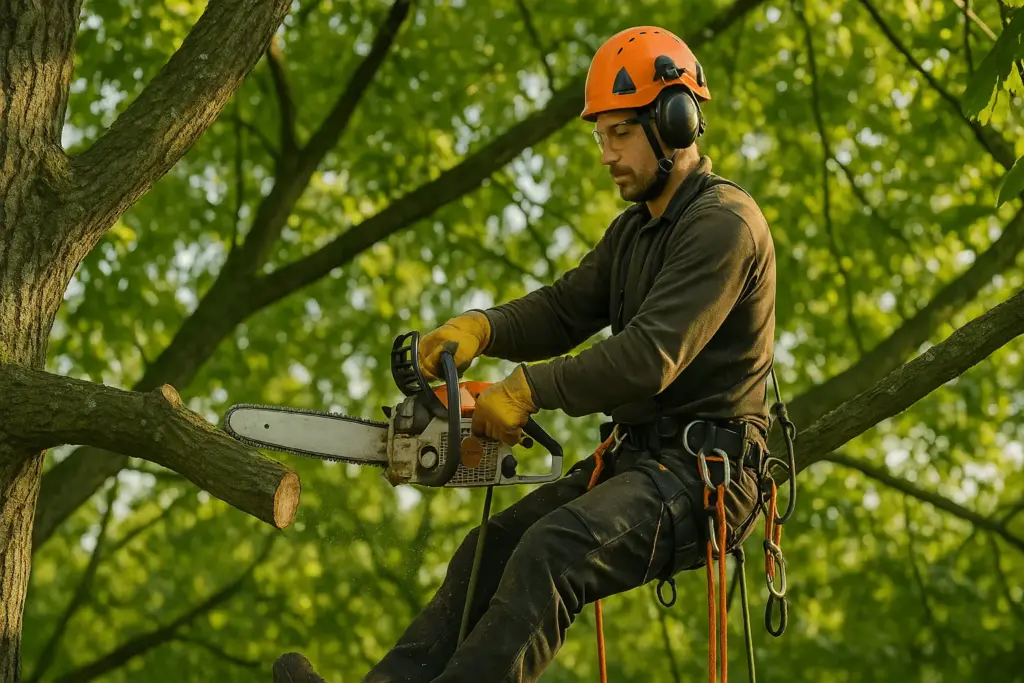
Not with a homeowner’s chainsaw. A trunk lying on a roof is under load and can roll, drop or spring when it is cut, and the framing under it may already be weakened. Crews normally take the tree apart in sections, and often lift the pieces off with a crane so that no extra weight lands on the structure.
Before work starts, tell your insurer and ask whether an adjuster needs to see the tree in place. If it has to come off right away to keep rain out, your photos are the record. Get the price in writing first. After storms, the department warns, some door-to-door contractors use high-pressure tactics, ask for cash up front or discourage you from calling your insurer.
What happens to the debris?
Ask what the quote covers. Lifting the tree off the structure, hauling the wood, chipping the brush and grinding the stump may be priced separately.
FirstEnergy says limbs its crews cut away from lines during storm restoration are left on site, and that cleanup is the property owner’s responsibility. The City of Toledo closes a tree report when its inspector finds the tree is on private property.
Tree fell on house FAQs
Who do you call first when a tree falls on your house?
911 if anyone is hurt, a wire is down, there is a fire or you smell gas. Otherwise Toledo Edison, then your insurer, then a tree service.
Does insurance cover a tree that fell on your house?
Usually, when the cause was a covered event such as wind. The Ohio Department of Insurance says a policy generally pays to repair the structure and contents and to remove the tree when it falls on a home, garage or fence, after your deductible. Many policies have a separate wind or hail deductible, so check yours.
What if the tree falls during a storm that is still going?
Move to the lowest level or an interior room, away from windows and from the damaged side of the house, which is the department’s shelter advice for severe weather. Photos and tarps can wait until the storm has passed.
Sources
- FirstEnergy: Downed Power Lines
- FirstEnergy: Report Power Outages
- FirstEnergy: Homeowner Rights and Responsibilities
- Columbia Gas of Ohio: Report Gas Leaks
- Ohio Department of Insurance: Severe Weather Toolkit
- Ohio Department of Insurance: Homeowners Insurance Guide
- Progressive: Does homeowners insurance cover fallen trees?
- City of Toledo: Report Tree Damage Concern

PK Barmon researches and writes the tree care guides on Tree Services Toledo Ohio. Every guide is built from primary sources such as Ohio State University Extension, the City of Toledo and Ohio state agencies, and each one lists its sources so you can check them.