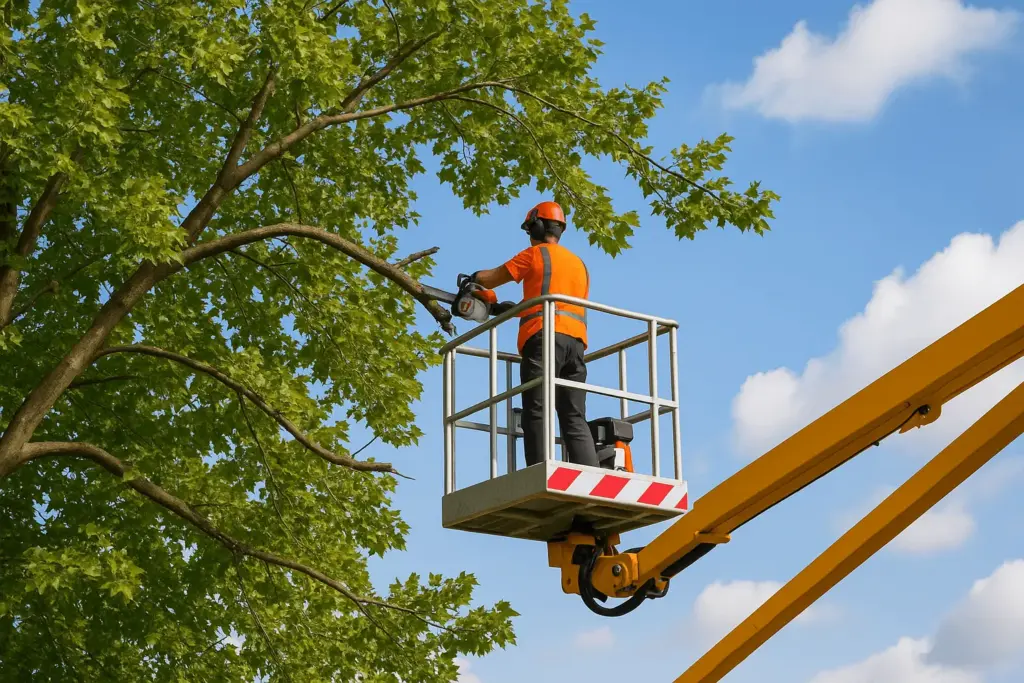
Quick answer: For most deciduous trees in Ohio, the best time to trim is the late dormant season, roughly February through March, before new growth starts. Oaks are the main exception: keep oak pruning to about November through March because of oak wilt. Dead, broken or hazardous limbs can come off at any time of year.
The right month depends on the kind of tree. The timings below come from Ohio State University Extension and, where its fact sheets do not cover a tree, from the Iowa State and Purdue extension services, two other Midwest universities. If you would sooner hand the job over, see our tree trimming service in Toledo. If a tree is too far gone to prune, see tree removal in Toledo.
The short answer for most trees
Late winter is the safe default. Iowa State University Extension names February through March as the best time for most deciduous trees, because the bare branches are easy to read and wounds seal fastest just before spring growth. It advises against pruning while trees are leafing out in spring or dropping leaves in fall.
Ohio State’s fact sheet on pruning and tree wounds puts the period of fastest wound closure in Ohio a little later, from March to June. The two overlap in March, which is why late winter into early spring is the usual recommendation.
| Tree | Best time in Ohio | Reason |
|---|---|---|
| Most shade trees | February to March | Dormant, structure visible, wounds close quickly in spring |
| Oaks | November 1 to March 31 | Avoids the beetles that spread oak wilt |
| Maples | Late winter, or midsummer to avoid sap flow | Late-winter cuts run with sap, which is harmless |
| Apple and other fruit trees | February or March, before buds break | Dormant, with fewer active diseases |
| Pines | Spring, at the candle stage | New growth can only be shortened while it is soft |
| Spring-flowering trees | Right after the flowers fade | Next year’s flower buds form on this year’s growth |
| Dead, broken or hazardous limbs | Any time | Safety comes first |
When should you trim oaks?
Only when they are dormant. Ohio State’s oak wilt fact sheet says oaks should never be wounded between April 15 and July 1, and that the more careful approach is to avoid wounds until October 1. An Ohio State Extension Buckeye Yard and Garden Line article stretches the avoid period to October 15 and names November 1 to April 1 as the dormant pruning window.
Metroparks Toledo reports oak wilt in several of its parks, so this is the one rule not to bend here. We explain it fully in when it is safe to prune oaks in Ohio.
When should you trim maples?
Maples can be pruned in late winter like other shade trees, but expect sap. An Ohio State Extension article from Erie County notes that most maples pruned in winter or early spring are sure to bleed. Iowa State says the sap loss does not hurt the tree and that the flow slows and stops.
If the dripping bothers you, Purdue Extension suggests pruning maples and birches in midsummer or late fall instead. More detail is in our guide on when to trim maples.
When should you trim fruit trees?
Late winter. Ohio State’s fact sheet on growing apples in the home orchard says mature apple trees should be pruned every year in February or March. Iowa State gives a similar window for fruit trees, late February through early April, finishing before the buds break.
For a neglected apple tree, the same Ohio State fact sheet advises taking out only two or three large limbs a year and restoring the shape over about three years.
Pines and other evergreens
Pines are pruned in spring, not winter. Iowa State advises shortening the new shoots, called candles, by one-half to two-thirds when they are about two to three inches long. Do not cut back into older wood, because a pine will not grow new shoots from it.
Spruce and fir can be cut back in early spring to just above a side bud or branch. Unwanted lower branches on evergreens are best removed in late winter, and dead, broken or diseased branches can be removed at any time.
Spring-flowering trees
Wait until the flowers fade. Purdue Extension’s rule is that a tree or shrub that blooms before the end of June should be pruned immediately after flowering, because its flower buds form on the previous season’s growth. Its list includes redbud, flowering dogwood, crabapple, flowering cherry, magnolia and hawthorn.
Pruning these trees in winter removes the buds that would have opened that spring.
Limbs that should not wait
Season does not matter for a dangerous limb. Ohio State’s pruning fact sheet says hazardous limbs should be removed at any time of year, including after ice and wind storms, and Purdue says storm-damaged plants should be pruned as soon as possible.
If the tree is an oak and the cut has to be made in the risk period, Ohio State advises painting the fresh wound with latex paint to keep beetles off it.
Ohio tree trimming timing FAQs
When is the best time to trim trees in the Midwest?
Late winter, February through March, for most deciduous trees, according to Iowa State University Extension. Oaks are pruned earlier in the dormant season and spring bloomers are pruned after they flower.
When should you trim pine trees in Ohio?
In spring, while the new candles are soft and about two to three inches long. Dead or broken pine branches can be removed whenever you notice them.
When should you trim fruit trees in Ohio?
February or March for apples, per Ohio State University Extension, and in any case before the buds break.
Sources
- Ohio State University Extension (Ohioline): Pruning and Care of Tree Wounds
- Ohio State University Extension (Ohioline): Oak Wilt
- Ohio State University Extension, Buckeye Yard and Garden Line: OK to prune OAKS. Now’s the time to schedule!
- Ohio State University Extension, Erie County: Why do Trees Bleed?
- Ohio State University Extension (Ohioline): Growing Apples in the Home Orchard
- Iowa State University Extension and Outreach: Proper Time to Prune Trees and Shrubs
- Iowa State University Extension and Outreach: When is the best time to prune shade trees?
- Purdue Extension: Pruning Ornamental Trees and Shrubs (HO-4-W)
- Metroparks Toledo: Invasive Forest Pests and Disease

PK Barmon researches and writes the tree care guides on Tree Services Toledo Ohio. Every guide is built from primary sources such as Ohio State University Extension, the City of Toledo and Ohio state agencies, and each one lists its sources so you can check them.