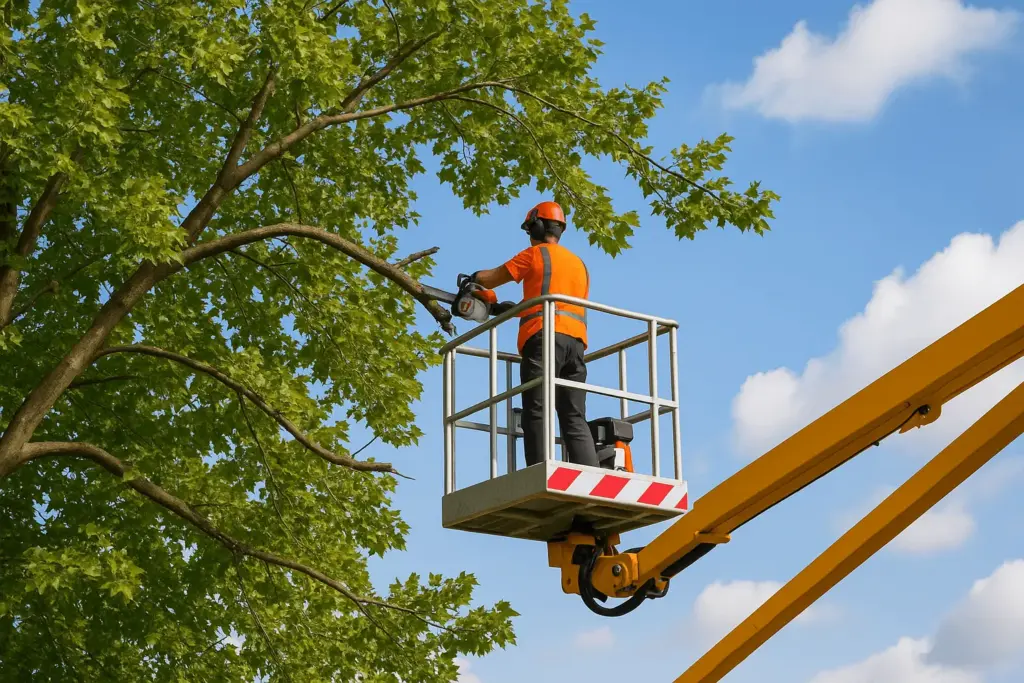
Quick answer: Topping cuts branches back to stubs, or to side branches too small to take over. The International Society of Arboriculture calls it perhaps the most harmful pruning practice known. Crown reduction also makes a tree smaller, but each limb is cut back to a side branch at least one-third its diameter, so the tree keeps its form. If a Toledo tree is too tall for its spot, ask for reduction, or weigh removal and replacement.
If you asked for a tall tree to be made shorter and were offered topping, this guide gives you the words to ask for something better. For the work itself, see crown reduction by our Toledo tree trimmers.
What is tree topping?
The International Society of Arboriculture (ISA) defines topping in its Why Topping Hurts Trees guide as the indiscriminate cutting of branches to stubs, or to side branches that are not large enough to take over as the new end of the limb. Other names include heading, tipping, hat-racking and rounding over.
The ANSI A300 pruning standard, as summarized by the Tree Care Industry Association, lists topping among pruning practices that are not acceptable and can injure trees. It describes topping as reducing a tree’s size with heading cuts back to a predetermined crown limit.
Why does topping harm a tree?
ISA’s reasons include these.
- Stress: topping can remove 50 to 100 percent of the leaf-bearing crown. Leaves make the tree’s food, so the tree is forced to push out fast new shoots from stored energy. A tree without enough reserves can be seriously weakened or die.
- Decay: a proper cut sits just beyond the branch collar, where the tree can close the wound. Topping cuts leave stubs the tree may not be able to close, and the exposed wood decays.
- Sunburn: bark that was shaded is suddenly exposed, which can lead to cankers, bark splitting and the death of some branches.
- Weak regrowth: the new shoots are anchored only in the outermost layers of the parent branch. In some species they can grow up to 20 feet in one year, and they are prone to breaking, especially in wind or ice.
Topping is often chosen because a large tree feels like a risk, and ISA’s conclusion is that it can raise the risk of limb failure instead. Purdue Extension’s Trees and Storms publication makes the same point about storms: topped trees grow weakly attached sprouts and added decay.
What is crown reduction?
Crown reduction is the accepted way to make a tree shorter or narrower. In ISA’s Pruning Mature Trees guide, leaders and branch ends are cut back to secondary branches large enough to take over, at least one-third the diameter of the stem being cut. The guide says this keeps the tree’s form and structure better than topping.
Reduction has limits. The same guide says that, in general, no more than 25 percent of the crown should be removed at once, and less on a mature tree. If the height you want would take far more than that, reduction is not the answer. Timing matters too: see when to trim trees in Ohio.
Topping vs. crown reduction
| Point | Topping | Crown reduction |
|---|---|---|
| Where the cut is made | Anywhere along the limb, leaving a stub | At a side branch at least one-third the diameter of the cut stem |
| Leaf area removed | Can be 50 to 100 percent of the crown | Generally no more than 25 percent, less on mature trees |
| Regrowth | Fast, crowded shoots with weak attachment | Growth continues through the remaining side branches |
| Wounds | Stubs that may not close, open to decay | Cuts placed just beyond the branch collar |
| Shape afterward | Natural form is lost | Natural form is kept |
What should you ask for on a quote?
Ask for the work in writing, in these terms:
- Crown reduction, with cuts made back to side branches of suitable size, and no stub cuts.
- Roughly how much of the crown will be removed.
- Which limbs are being shortened, and why.
Be wary of a quote that promises to take a set number of feet off the top without saying where each cut ends. Our guide to pruning versus trimming explains what each pruning type means.
When is removal the better choice?
Sometimes the tree is simply the wrong size for the place. ISA says plainly that the best solution can be to remove the tree and replace it with a more appropriate species. That is worth weighing when a large-growing tree stands under wires or tight against the house and would need heavy cutting again and again.
Tree topping FAQs
Is tree topping cheaper than crown reduction?
It may be quoted lower on the day. ISA’s point is about what follows: a topped tree that survives is likely to need corrective pruning within a few years, and one that dies has to be removed. ISA also notes that healthy, well-maintained trees can add 10 to 20 percent to a property’s value.
Is tree topping the same as pruning?
No. Pruning removes chosen branches at the right point for a stated reason. Topping cuts limbs to a height without regard to where the cut lands, and the pruning standard lists it as a practice that is not acceptable.
Can a topped tree be fixed?
Partly. Corrective pruning over time can improve its structure, but ISA states that a topped tree can never fully regain its natural form. Have the regrowth checked, because those fast shoots are prone to breaking.
Sources

PK Barmon researches and writes the tree care guides on Tree Services Toledo Ohio. Every guide is built from primary sources such as Ohio State University Extension, the City of Toledo and Ohio state agencies, and each one lists its sources so you can check them.